Quick Reminder: What's a Database?
| Question | SQL | NoSQL |
|---|---|---|
| How is data stored? | Tables (like Excel) | Documents (like files) |
| Is the format fixed? | Yes, same for all | No, can be different |
| Best example? | Phone Contacts | Notes App |
A database is just a place to store information on a computer.
Like your phone stores contacts, a database stores data for apps and websites.
Now, there are two main types of databases. Let's learn them!
The Simple Analogy
| Question | SQL | NoSQL |
|---|---|---|
| How is data stored? | Tables (like Excel) | Documents (like files) |
| Is the format fixed? | Yes, same for all | No, can be different |
| Best example? | Phone Contacts | Notes App |
Imagine you want to save information about your friends:
SQL Database = Your Phone Contacts
Every contact has the same fields:
- Name
- Phone Number
You can't add "Favorite Food" for just one friend. Everyone has the same fields.
NoSQL Database = Your Notes App
You can write anything:
- "John - 9876543210 - loves pizza"
- "Mary - met at college, has a dog named Bruno"
- "Tom - email: [email protected]"
Each note can be completely different!
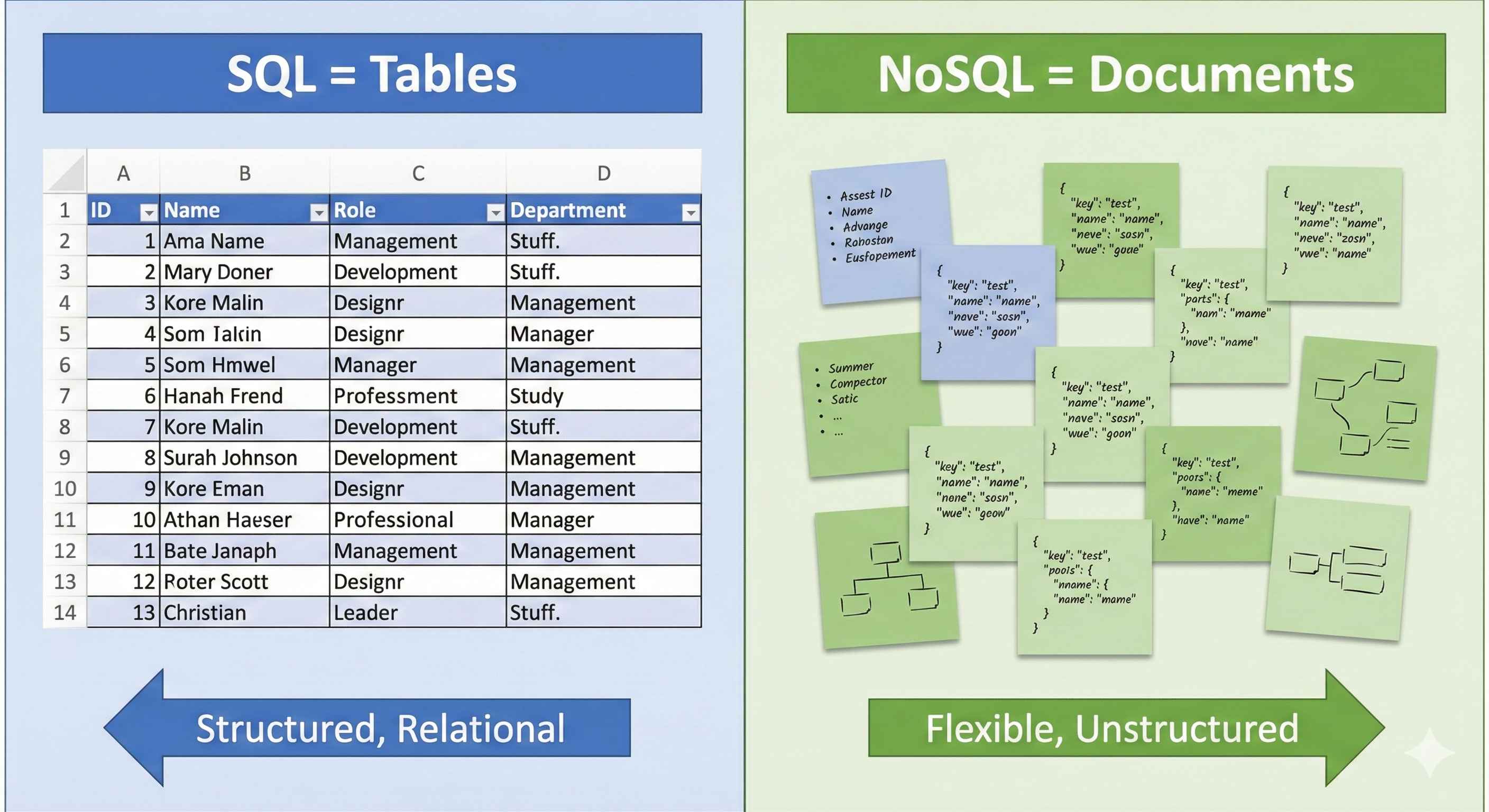
SQL Database Explained
| Question | SQL | NoSQL |
|---|---|---|
| How is data stored? | Tables (like Excel) | Documents (like files) |
| Is the format fixed? | Yes, same for all | No, can be different |
| Best example? | Phone Contacts | Notes App |
SQL stands for "Structured Query Language"
Think of it like an Excel spreadsheet:
- Data is stored in tables (like sheets)
- Every row has the same columns
- Very organized and neat
Where is SQL used?
- Banks (your account balance)
- Amazon (product listings)
- Schools (student records)
Popular SQL databases: MySQL, PostgreSQL
NoSQL Database Explained
| Question | SQL | NoSQL |
|---|---|---|
| How is data stored? | Tables (like Excel) | Documents (like files) |
| Is the format fixed? | Yes, same for all | No, can be different |
| Best example? | Phone Contacts | Notes App |
NoSQL means "Not Only SQL"
Think of it like a folder of documents:
- Each document can have different information
- No fixed format required
- Very flexible
Where is NoSQL used?
- Instagram (posts with different content)
- WhatsApp (messages)
- Netflix (movie recommendations)
Popular NoSQL databases: MongoDB, Firebase
Side-by-Side Comparison
| Question | SQL | NoSQL |
|---|---|---|
| How is data stored? | Tables (like Excel) | Documents (like files) |
| Is the format fixed? | Yes, same for all | No, can be different |
| Best example? | Phone Contacts | Notes App |
Which One Should You Learn First?
| Question | SQL | NoSQL |
|---|---|---|
| How is data stored? | Tables (like Excel) | Documents (like files) |
| Is the format fixed? | Yes, same for all | No, can be different |
| Best example? | Phone Contacts | Notes App |
Start with SQL!
Why?
- Most companies use SQL
- Easier to understand for beginners
- Great foundation for learning NoSQL later
Don't worry about NoSQL right now. This course focuses on SQL, and that's exactly what you need!
Real World Example: Instagram
| Question | SQL | NoSQL |
|---|---|---|
| How is data stored? | Tables (like Excel) | Documents (like files) |
| Is the format fixed? | Yes, same for all | No, can be different |
| Best example? | Phone Contacts | Notes App |
Instagram uses BOTH:
SQL for: User accounts (name, email, password - same for everyone)
NoSQL for: Posts (some have photos, some have videos, some have both)
Key Takeaway
| Question | SQL | NoSQL |
|---|---|---|
| How is data stored? | Tables (like Excel) | Documents (like files) |
| Is the format fixed? | Yes, same for all | No, can be different |
| Best example? | Phone Contacts | Notes App |
SQL = Organized data, same format for everything (like a form)
NoSQL = Flexible data, different format allowed (like notes)
You Did It!
| Question | SQL | NoSQL |
|---|---|---|
| How is data stored? | Tables (like Excel) | Documents (like files) |
| Is the format fixed? | Yes, same for all | No, can be different |
| Best example? | Phone Contacts | Notes App |
You've completed Step 1 - The Basics!
You now understand:
- What databases are
- What RDBMS means
- The difference between SQL and NoSQL
Next up: Time to write your first SQL command!